


Who owns football?

“Football’s staying home,” proclaims this morning’s Sun.
Like most newspapers, it leads on UEFA’s challenge to FIFA’s proposal to allow private investors to buy a stake in a company responsible for running and marketing competitions including the World Cup.
As I write, the Asian Football Confederation has joined the opposition. So, by the time you read this, Gianni Infantino’s proposal may already have been kicked into touch—rather like the ill-fated European Super League five years ago.
Underlying all this is one question: Who owns football? Or, more precisely, who owns our football clubs?
It has always seemed strange to me that an extremely wealthy person—often someone with no connection to the town, city or country concerned—can buy a club with a cherished tradition and generations of supporters.
That is why we see protests from aggrieved fans carrying banners declaring: “Hands off our club!”
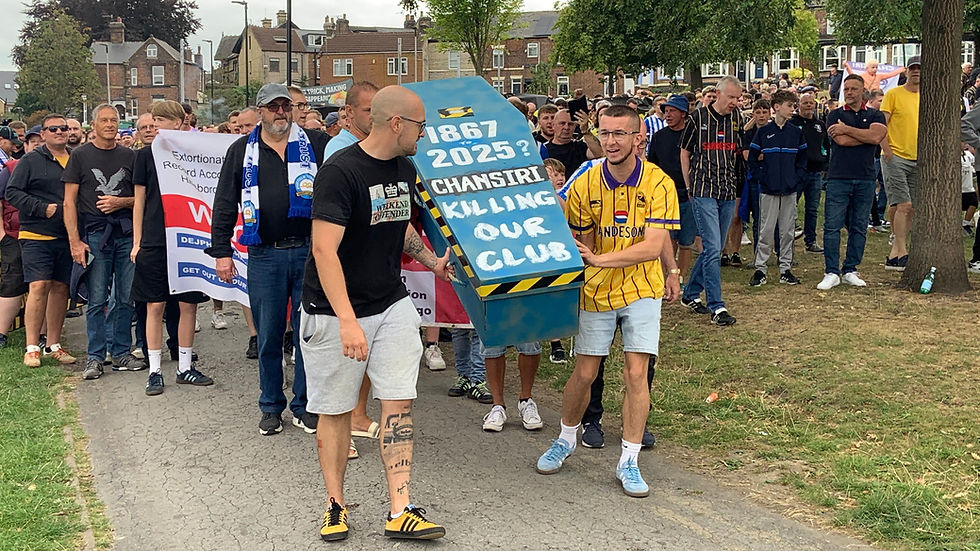
Most recently, Sheffield Wednesday. During the final years of Dejphon Chansiri’s ownership, supporters organised boycotts, demonstrations and pitch protests. They believed their club’s identity and future were being placed at risk.
Then there is my own club, Everton.
Three years ago, supporters and minority shareholders opposed the proposed sale to 777 Partners, an American investment company whose financial and legal difficulties were becoming apparent.
We find ourselves in a hinterland. Legally, the club belongs to its shareholders. Emotionally, historically and culturally, it belongs to its supporters.
I have often blogged about Everton’s origins. In 1878, the Revd Ben Swift Chambers helped form St Domingo’s Football Club. Somehow we have reached the point where, in December 2024, the Friedkin Group of Texas bought the club for around £500 million.
To my surprise, I have only recently discovered that Everton formally became a limited company on 14 June 1892.
But did those responsible realise the long-term implications of what they were doing?
In contrast, some big European clubs are owned by their fans, including Real Madrid, Barcelona and Bayern Munich. The world’s richest club, Real Madrid, is owned by roughly 100,000 members.
No doubt the struggle will still continue between profit-seeking owners and supporters who see their club as part of their identity.
Which raises another question: Who owns the Church?
Beneath all this lies much the same tension as with football clubs. Every vicar will eventually hear aggrieved church members demand: “What are you doing to our church?”
At that point, we are no longer talking simply about the church building. We mean the whole operation: the congregation, its worship, traditions, relationships and place within the community. We mean what the New Testament calls the body of Christ.
Here the apostle Paul was in no doubt: “Now you are the body of Christ and individually members of it.” (1 Corinthians 12:27)
The Church belongs neither to the clergy nor to a handful of officials. Neither does it belong to the loudest group in the congregation, the family which has worshipped there longest, or those who contribute most generously.
All its people together make up the body of Christ.
I was always careful not to call Christ Church “my church”. Whenever I faced another problem, I learned from my earliest days as a vicar to pray: “Lord, this is your church, your responsibility, your problem. Is there anything you want me to do?”
It was not a prayer intended to evade responsibility. Quite the opposite. It put my responsibility into its proper context.
The Church is God’s idea before it is ours. Its life does not depend ultimately upon the ability of its clergy, the wisdom of its committees, the generosity of its congregations or the ingenuity of its latest mission strategy. Christ assumes responsibility for his Church because it belongs to him.
However, the football comparison eventually breaks down. We are not merely supporters watching from the stands, complaining about the manager and hoping that the owner will invest more money. We are members of the body. Each of us has a part to play.
And Christ is not some distant proprietor who bought the Church as a financial investment. Paul told the elders at Ephesus to care for the Church of God, which Christ had bought “with his own blood.” That is the decisive answer to the question of ownership.
We are not proprietors but stewards; not customers but participants; not spectators but members of Christ’s body.
So whenever the Church faces uncertainty, conflict or seemingly impossible problems, perhaps that simple prayer remains the best place to begin: “Lord, this is your Church. What do you want us to do?”
It is his Church, bought at the price of the cross.
And that makes all the difference.


Comments